
Home › From the Land › No. 01
Kimchi
Cabbage, salt, chilli, time — and a few hundred years of knowing exactly how long.
- Region
- Korea
- Season
- Late autumn
- Practice
- Ferment
- Plant / organism
- Brassica rapa · Lactobacillus
- Tradition
- Documented for 1,500+ years
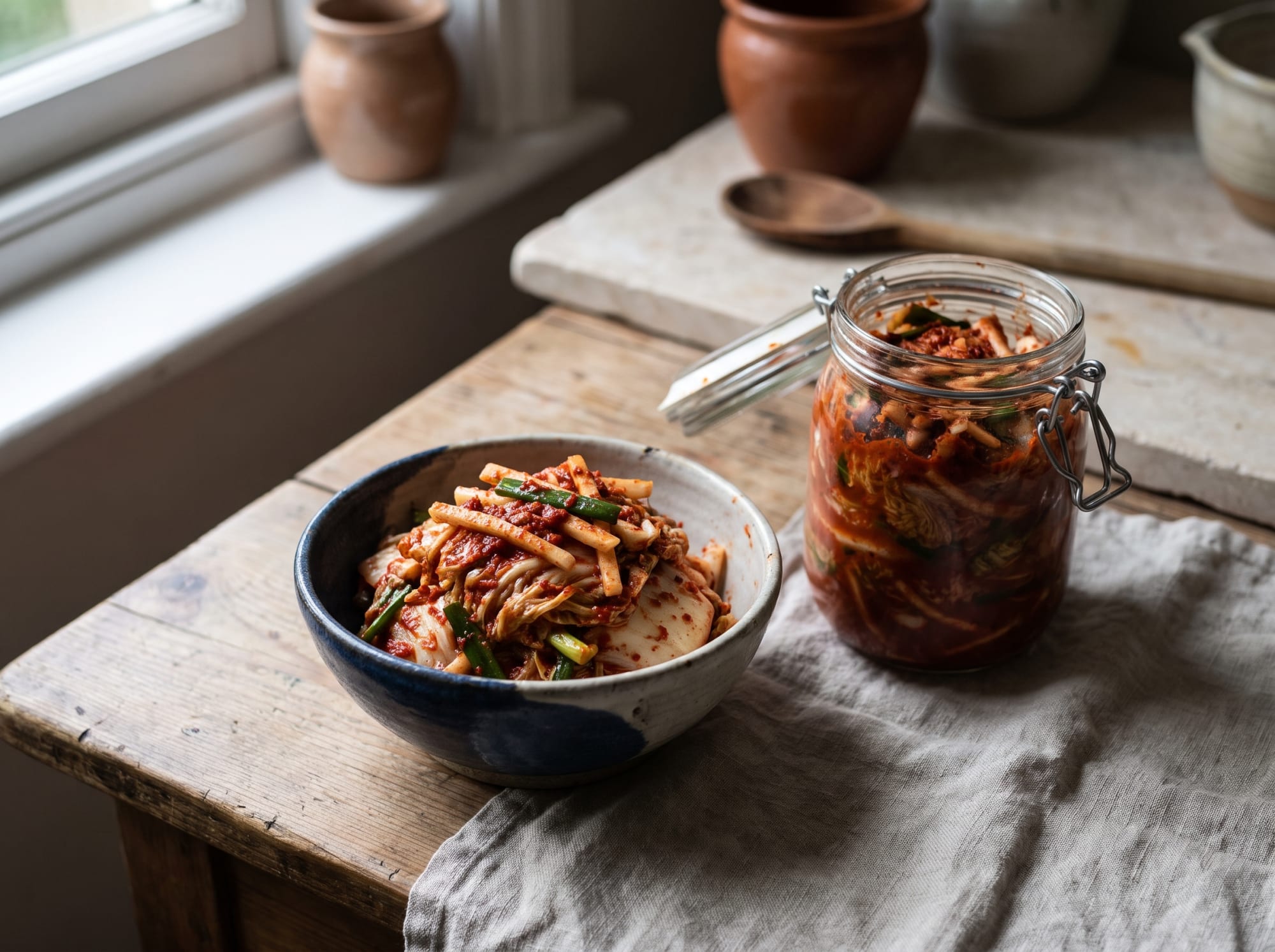
Every cold country worked out how to keep vegetables through winter. Korea's answer became the national dish, the subject of a UNESCO listing, and the reason many households once owned a second fridge.
Make it
Simple napa kimchi
One 1L jar · 40 min active · 3–5 days to ferment
Ingredients
- 1 medium napa cabbage (about 1 kg)
- ¼ cup coarse sea salt (not iodised)
- 4 cloves garlic, grated
- 1 tbsp fresh ginger, grated
- 1 tbsp sugar
- 2–4 tbsp gochugaru (Korean chilli flakes)
- 1 tbsp fish sauce, or 1 tbsp soy sauce for a vegan jar
- 4 spring onions, cut in 3cm lengths
- ½ daikon or 1 carrot, cut in matchsticks
Instructions
- Quarter the cabbage lengthways and cut into 4cm pieces. Toss thoroughly with the salt in a large bowl and add enough cold water to cover. Weigh it down with a plate and leave 2 hours.
- Rinse the cabbage three times in cold water and drain well. Taste a piece — it should be pleasantly salty, not harsh. Rinse again if it is.
- Mix the garlic, ginger, sugar, gochugaru and fish sauce into a paste.
- Wearing gloves if you value your fingertips, rub the paste through the cabbage until every piece is coated. Fold in the spring onion and daikon.
- Pack tightly into a clean jar, pressing down hard so the brine rises above the vegetables. Leave 3cm of headroom — it will bubble up.
- Leave at room temperature 3–5 days, opening the jar once a day to release pressure and pressing the vegetables back under the brine. Taste from day 3.
- When it tastes right to you, refrigerate. It keeps for months and gets sourer as it goes. Older kimchi is better for cooking; younger is better raw.
Nutrition notes
Two things are happening in the jar, and they're worth separating.
The vegetable is being preserved
Salt draws water out of the cabbage and creates conditions where most spoilage organisms can't survive but lactic acid bacteria can. Those bacteria eat the sugars in the vegetable and produce lactic acid, which drops the pH and preserves everything. This is the same process behind sauerkraut, curtido, and dill pickles done the old way.
The bacteria are alive
Unpasteurised kimchi contains substantial live Lactobacillus populations. Whether eating them meaningfully changes your own gut bacteria is a genuinely open question — most research suggests fermented-food organisms are transient rather than permanent colonists, though transient may still be useful.
What we can say more confidently: fermented vegetables are vegetables. You get the fibre, the vitamin C (which survives fermentation surprisingly well), and the carotenoids. If a jar of kimchi in the fridge means you eat more vegetables than you otherwise would, that alone is worth it.
A 2021 review in Nutrients and similar work on fermented foods generally point in a promising direction for gut health, but the studies are mostly small, short and often not in humans. I'd call it encouraging rather than established.
The salt question
Kimchi is salty — that's the mechanism, not a flaw. If you've been advised to watch sodium, this is a portion-size conversation, not an avoid-entirely one. A few tablespoons alongside a meal is a very different thing from a bowlful.
Where a supplement might come in
This is one of the clearest cases where food genuinely beats a capsule, and where a supplement is usually the wrong answer.
A probiotic capsule delivers specific, named strains in a known dose — which is exactly what you want if you're targeting something particular, and it's why practitioners use them for defined situations over defined periods. What it doesn't give you is the fibre, the vitamin C, the plant compounds, or the several hundred grams of vegetables that came with it.
If you're eating fermented vegetables regularly and enjoying them, you almost certainly don't need a general "gut health" probiotic on top. If your digestion is genuinely troubling you, that's a conversation with your doctor first and me second — not a supplement to guess at.
Where it comes from
Before refrigeration, the problem was simple and enormous: a Korean winter is long, and fresh vegetables are not. The solution was kimjang — the late-autumn ritual of making enough kimchi to last until spring, done communally, usually by women, over several days.
Families buried earthenware onggi jars up to their necks in the ground, where the soil held a steady cool temperature and the porous clay let the ferment breathe. UNESCO added kimjang to its Intangible Cultural Heritage list in 2013 — not for the recipe, but for the practice of neighbours making it together.
Chilli, incidentally, is the newcomer. Peppers only reached Korea in the 1600s. For most of kimchi's history it was white — salt, garlic, ginger, sometimes fermented seafood. Baek-kimchi is still made that way and it's excellent.
Nutrients noted for this entry: Fibre · vitamin C · live lactic acid bacteria.
Please read
This is general food and nutrition education, not medical advice. Nothing here is intended to diagnose, treat, cure or prevent any disease or condition. If you are pregnant or breastfeeding, taking any medication, or managing a diagnosed condition, speak with your doctor or pharmacist before making changes.
Written by Mellissa Wallace, Registered Holistic Nutritionist, Okanagan BC.
More from the land
Keep reading
Japan
味噌
No. 11