
Home › From the Land › No. 05
Rosehip
One of the richest sources of vitamin C that grows wild in Canada — and it improves after a hard frost.
- Region
- Northern Europe · BC
- Season
- After the first frost
- Practice
- Forage
- Plant / organism
- Rosa canina, R. acicularis, R. nutkana
- Tradition
- Wartime Britain; Indigenous use far older
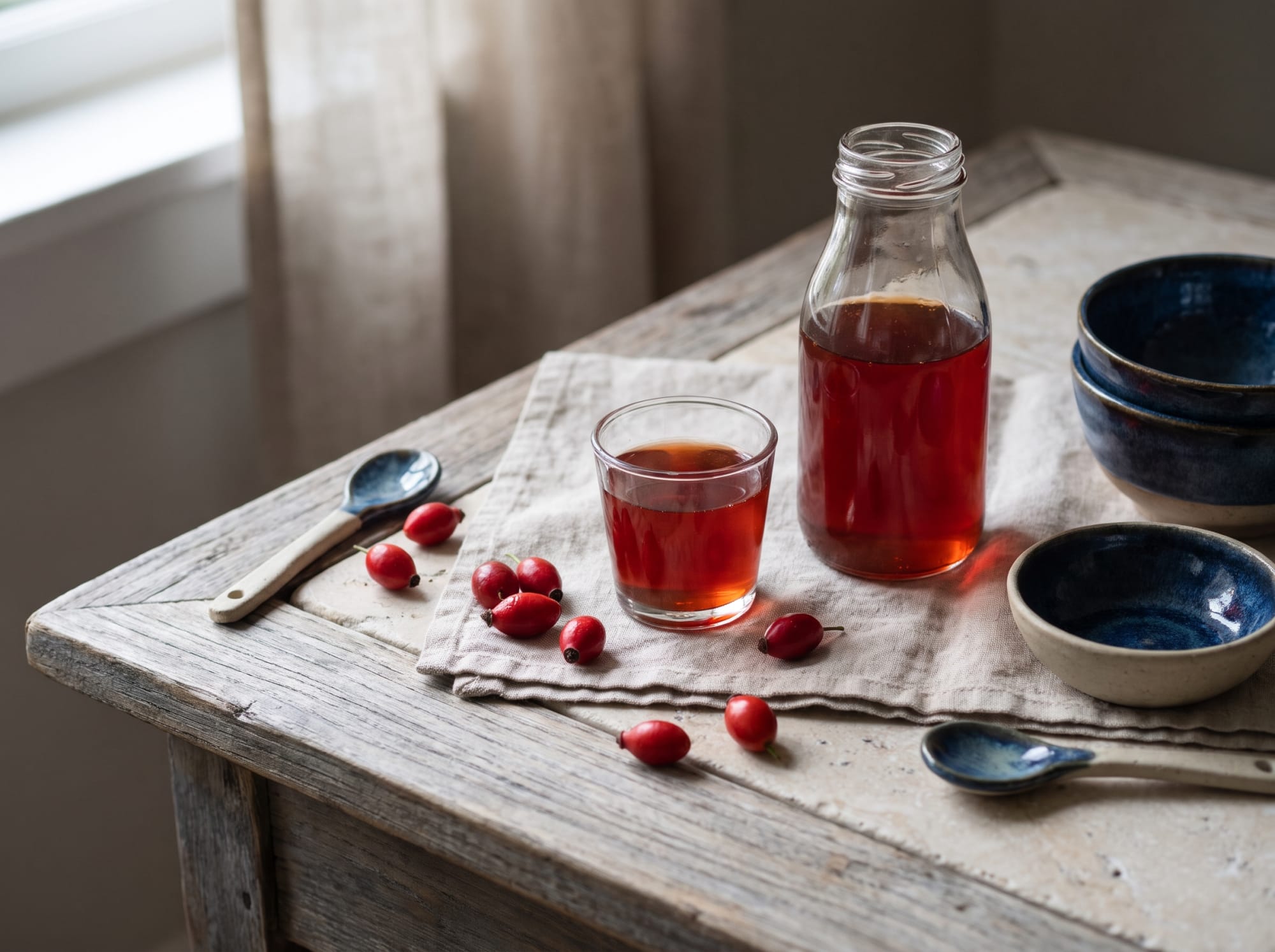
In 1941, with citrus imports cut off by German submarines, the British government organised schoolchildren to collect rosehips from hedgerows. They gathered hundreds of tonnes a year, and it worked.
Safety
Two real hazards. The seeds inside a rosehip are covered in fine hairs that are a genuine irritant to skin and to the gut — historically they were used as itching powder. Strain thoroughly through muslin every time, and never squeeze the bag. Second: only pick from plants you can positively identify as rose, well away from roadsides, sprayed verges and industrial ground. If you are not completely certain what a plant is, do not eat it.
Make it
Rosehip syrup, the low-heat way
About 500ml · keeps 3 months refrigerated
Ingredients
- 1 kg ripe rosehips, picked after a frost
- 1.5 L water
- 400g sugar
- A jelly bag or a double layer of muslin
Instructions
- Top and tail the hips and roughly chop or pulse them. Do not skip the straining steps later — the seeds are covered in fine irritant hairs.
- Bring 1 L of the water to the boil, take it off the heat, add the chopped hips, and leave to infuse 15 minutes off direct heat. Keeping it below a rolling boil preserves far more vitamin C.
- Strain through the jelly bag and let it drip. Don't squeeze it — that pushes the hairs through.
- Return the pulp to the pan with the remaining 500ml water, infuse another 15 minutes, and strain again through a fresh clean bag.
- Combine both liquids, add the sugar, and warm gently, stirring, only until the sugar dissolves. Do not boil hard.
- Bottle into sterilised bottles. Refrigerate after opening. A tablespoon over yoghurt or porridge, or in hot water.
Nutrition notes
The vitamin C is the headline, and it deserves to be. Fresh rosehips typically run in the range of 300–1,300 mg of vitamin C per 100g depending on species and ripeness — roughly ten to twenty times the concentration in an orange. That is a genuinely remarkable number for something growing in a ditch.
The important caveat: vitamin C is destroyed by prolonged heat. A long boil takes much of it out. Traditional syrup recipes that steep rather than boil hard, and modern methods using a shorter infusion, preserve substantially more. Drying also degrades it, though dried hips still carry a useful amount.
Rosehips also contain carotenoids, notably lycopene and beta-carotene, plus a good deal of pectin — which is why rosehip preparations set into a jelly so readily.
There is a reasonable body of research on standardised rosehip powder and joint comfort in osteoarthritis, including some randomised trials with modest positive results. I want to be careful here: that research is on specific standardised preparations at specific doses, and it is not a claim I can make about a cup of tea you brewed at home. If joint pain is your concern, that belongs with your doctor.
Where a supplement might come in
Vitamin C supplements are cheap, safe at sensible doses, and well understood — this is not a case where I'd argue the wild food is dramatically superior for the nutrient alone.
What the rosehips give you that a tablet doesn't: the carotenoids, the pectin, an afternoon outdoors, and a syrup that makes winter porridge worth eating. Those aren't nutritional arguments, and I think they still count.
Worth saying plainly: very high-dose vitamin C supplements mostly produce expensive urine, and above about 2,000 mg a day can cause digestive upset and, in susceptible people, kidney stones. More is not better here.
Where it comes from
The wartime rosehip syrup scheme is the famous story, but it's late in the plant's history. Rosehips have been food and medicine across the northern hemisphere for as long as anyone can trace, and the wild roses of British Columbia — Nootka rose and prickly rose in particular — have long been used by Indigenous peoples here, both as food and in other ways I'm not the right person to speak about in detail.
What's consistent across traditions is the timing. Pick after the first hard frost. This is not folklore — freezing ruptures the cell walls, which softens the flesh and makes it noticeably sweeter. Before frost they're astringent and hard work.
In Sweden, nyponsoppa — rosehip soup — is still sold in cartons and eaten hot with cream and almond biscuits. In Turkey and Iran, rosehip tea is everyday. In Britain the syrup went over porridge and into children.
Nutrients noted for this entry: Exceptional vitamin C · carotenoids · pectin.
Please read
This is general food and nutrition education, not medical advice. Nothing here is intended to diagnose, treat, cure or prevent any disease or condition. If you are pregnant or breastfeeding, taking any medication, or managing a diagnosed condition, speak with your doctor or pharmacist before making changes.
Written by Mellissa Wallace, Registered Holistic Nutritionist, Okanagan BC.
More from the land
Keep reading
Wetlands across Canada
Typha latifolia
No. 07