
Home › From the Land › No. 09
The Chopped Salad
Cucumber and tomato cut small, dressed with lemon and oil — eaten at breakfast, which is the interesting part.
- Region
- The Levant
- Season
- Peak summer, but year round
- Practice
- Everyday
- Plant / organism
- Cucumis sativus · Solanum lycopersicum
- Tradition
- Regional across the eastern Mediterranean
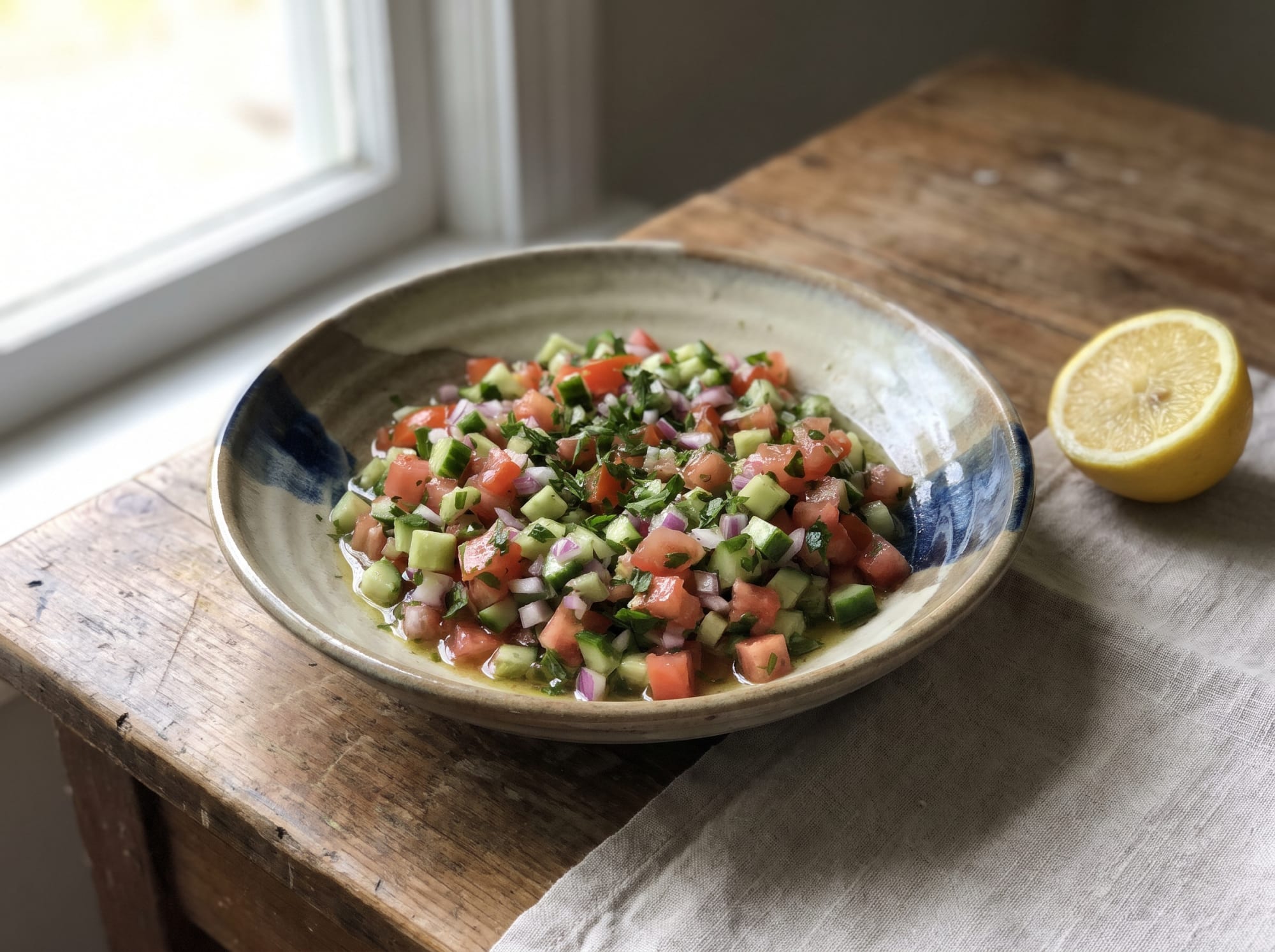
A dish so simple it barely qualifies as a recipe, and so widespread across the eastern Mediterranean that arguing about whose it is has become a hobby in itself.
Make it
Chopped salad, properly small
Serves 4 · 15 minutes
Ingredients
- 4 firm tomatoes, seeds left in
- 3 small cucumbers (Persian or Lebanese if you can get them)
- ½ small red onion
- 1 large handful flat-leaf parsley
- Juice of 1 lemon
- 3 tbsp good olive oil
- Salt and black pepper
- Optional: mint, sumac, a little feta, or a spoon of tahini
Instructions
- Cut everything into 5mm dice. This is the entire technique and it is worth the ten minutes. A sharp knife matters more than skill.
- If your onion is aggressive, soak the dice in cold water 5 minutes and drain. This takes the harsh edge off without losing the flavour.
- Chop the parsley finely — stalks as well as leaves, they carry plenty of the flavour.
- Combine everything and dress with the lemon and oil. Salt generously; it needs more than you think.
- Eat within the hour. It weeps if it sits, and the texture is the point.
Nutrition notes
Why breakfast matters here. Most people's breakfast is carbohydrate with very little else — cereal, toast, a pastry. Adding vegetables and protein at that meal is the single change I suggest most often, and this dish is one of the easiest ways to do it. (There's more on why in the energy guide.)
Tomato and oil belong together. Lycopene is fat-soluble, so it is absorbed considerably better in the presence of fat. Olive oil on tomato isn't just tradition — it measurably increases how much lycopene you take up. Cooking tomatoes increases availability further, which is why both this salad and a long-simmered sauce have a place.
Vitamin C and iron. If this sits alongside beans, lentils, eggs or bread, the vitamin C helps you absorb the non-heme iron from them. This is the same mechanism as in the harira entry, showing up in a completely different cuisine. Traditional food cultures worked out these pairings by taste and long observation, not biochemistry.
Water and potassium. Cucumber is about 95% water and carries useful potassium. In a hot climate, a water-and-mineral-rich dish at every meal is doing real physiological work.
Where a supplement might come in
Nothing to supplement here, and that's rather the point of including it.
This dish is what "eat more vegetables" looks like when it stops being advice and becomes a habit. It takes fifteen minutes, costs very little, keeps for a day, and goes with almost anything.
If a client tells me they want to eat better and they don't know where to start, this is frequently the first thing I suggest — not because it's remarkable, but because it's repeatable. The best nutritional intervention is the one you're still doing in March.
Where it comes from
Finely chopped cucumber and tomato with lemon, olive oil, salt and herbs appears right across the region under many names — salata, çoban salatası (shepherd's salad) in Turkey, and versions throughout the Levant. In Israel it's salat yerakot and it's on the table at essentially every meal, including breakfast.
That breakfast habit is what interests me nutritionally. The standard Israeli hotel breakfast — salad, eggs, cheese, olives, bread — is a genuinely well-constructed meal, and it looks nothing like what most Canadians eat in the morning.
The chopping is not incidental. Cut small — properly small, 5mm dice — the whole thing changes texture and the dressing coats every piece. Cut large and it's just a bowl of vegetables.
What it belongs to is a broader eastern Mediterranean pattern of eating: vegetables at every meal, olive oil as the main fat, legumes often, and fresh acidity used constantly. That pattern, rather than any single dish, is what the research on Mediterranean eating actually points at.
Nutrients noted for this entry: Vitamin C · lycopene · potassium · water.
Please read
This is general food and nutrition education, not medical advice. Nothing here is intended to diagnose, treat, cure or prevent any disease or condition. If you are pregnant or breastfeeding, taking any medication, or managing a diagnosed condition, speak with your doctor or pharmacist before making changes.
Written by Mellissa Wallace, Registered Holistic Nutritionist, Okanagan BC.
More from the land
Keep reading
Siberia · Urals
пельмени
No. 10