
Home › From the Land › No. 13
Dandelion
The plant most people spend money removing from their lawn, and one of the first greens of the year.
- Region
- Everywhere
- Season
- Leaves early spring · roots autumn
- Practice
- Forage
- Plant / organism
- Taraxacum officinale
- Tradition
- Food and medicine across Europe and Asia for centuries
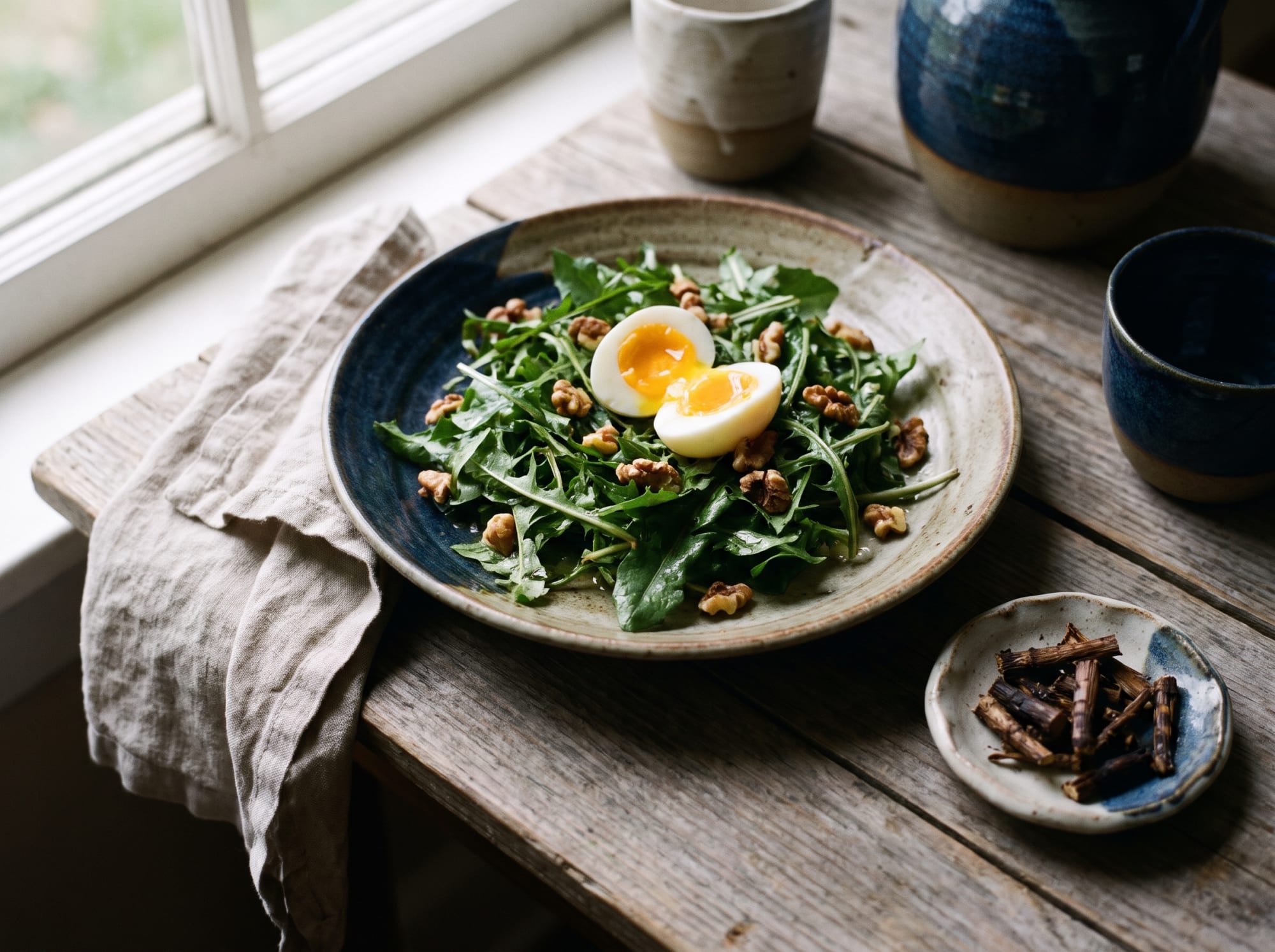
Dandelion is where a lot of people's foraging starts, mine included. It is also the clearest example of a food we decided was a weed.
Safety
Read before picking or taking any dandelion product.
Where you pick matters enormously. Dandelions thrive exactly where lawns are sprayed with herbicide, where dogs are walked and beside roads. Only pick from ground you know has not been treated, well back from traffic.
Allergy. Dandelion is in the Asteraceae family, along with ragweed, chrysanthemum, marigold and daisy. If you react to those, treat dandelion with real caution.
Medication. Because of its diuretic effect and high potassium, dandelion can interact with diuretics ("water pills"), blood pressure medication, lithium and some diabetes medication. If you take any of these, speak to your pharmacist before making dandelion a regular thing — they will check it for you free.
Gallbladder and bile ducts. Avoid if you have gallstones or a blocked bile duct without medical advice.
Make it
Roasted dandelion root, and a spring leaf salad
Root: about 1 cup dried · Salad: serves 2
Ingredients
- FOR THE ROOT — a good handful of dandelion roots, dug in autumn
- FOR THE SALAD — 2 large handfuls young dandelion leaves, picked before flowering
- 2 rashers bacon, or a handful of toasted walnuts
- 1 soft-boiled egg per person
- 1 tbsp cider vinegar, 3 tbsp olive oil, 1 tsp honey, salt and pepper
Instructions
- ROOT: scrub the roots hard under cold water — they hold a lot of soil. Chop into 1cm pieces.
- Spread on a tray and roast at 150°C for 1–2 hours, turning occasionally, until dark brown, dry and brittle. Watch them near the end; they go from roasted to burnt quickly.
- Cool completely, then store airtight. To drink, simmer a heaped teaspoon in a cup of water for 10 minutes and strain.
- SALAD: wash the leaves well and dry them properly. Wet leaves will not hold dressing.
- Crisp the bacon (or toast the walnuts) and keep the fat in the pan.
- Whisk the vinegar, honey, salt and pepper, then the oil, and add any warm bacon fat. The dressing needs to be sharper and sweeter than usual to stand up to the bitterness.
- Toss the leaves while the dressing is still warm — it wilts them slightly and takes the edge off. Top with the egg and the bacon or walnuts.
Nutrition notes
The leaves are a genuinely good green. Dandelion leaves are notably high in vitamin K, carry useful vitamin A as beta-carotene, and are a good source of potassium. Nutritionally they sit comfortably alongside spinach or chard rather than below them.
The bitterness is doing something. Bitter compounds stimulate saliva and digestive secretions — this is the mechanism behind the whole European tradition of bitter aperitifs before a meal. It is a real physiological response, though I would not stretch it into claims about detoxification, which is a word I would rather we all used less.
The root is mostly inulin, a soluble fibre that feeds gut bacteria. Inulin is a prebiotic in the proper sense of the word. It is also, in quantity, a fairly reliable way to produce wind, so build up slowly.
On the diuretic reputation: dandelion leaf does appear to have a mild diuretic effect, and the French name for it — pissenlit — suggests people noticed a long time ago. The human evidence is limited. More importantly, this is exactly why it matters if you take medication (see the cautions below).
Where a supplement might come in
Dandelion is sold as capsules, tinctures and teas, usually for digestion or as a "liver support" or "detox" product.
I will be direct about that last category: your liver and kidneys do that work continuously and do not need a herbal product to be switched on. Products marketed as detoxes are selling a story rather than a mechanism. If your liver genuinely is not working properly, that is a serious medical matter and belongs with a doctor immediately.
The bitter-before-a-meal tradition is a different and more modest claim, and a cup of dandelion tea or a few leaves in a salad is a perfectly reasonable way to explore it. Cheaper than capsules, too.
Where it comes from
Every part of a dandelion has been eaten somewhere. The young leaves as a spring green, the roots roasted as a coffee substitute, the flowers into wine and syrup, the buds pickled like capers.
The timing matters more than with almost any other wild green. Pick the leaves early — before the plant flowers — and they are pleasantly bitter and tender. Pick them in July and they are ferociously bitter and tough. Frost improves them again in autumn.
Roots are dug in autumn, when the plant has pulled its energy back down for the winter. Scrubbed, chopped, dried and roasted, they make a dark, slightly sweet drink that tastes nothing like coffee but is good on its own terms.
There is an argument worth making here about the word "weed". Dandelion is a nutrient-dense, freely available, endlessly abundant green that most of North America pays to poison. That is a fairly recent decision and not an obviously sensible one.
Nutrients noted for this entry: Vitamin K · vitamin A · potassium · inulin in the root.
Please read
This is general food and nutrition education, not medical advice. Nothing here is intended to diagnose, treat, cure or prevent any disease or condition. If you are pregnant or breastfeeding, taking any medication, or managing a diagnosed condition, speak with your doctor or pharmacist before making changes.
Written by Mellissa Wallace, Registered Holistic Nutritionist, Okanagan BC.
More from the land
Keep reading
Northern Europe · BC
Rosa canina
No. 05