
Home › From the Land › No. 12
Injera & Teff
A sour, spongy, metre-wide flatbread that is simultaneously the plate, the cutlery and the meal.
- Region
- Ethiopia · Eritrea
- Season
- Year round
- Practice
- Ferment
- Plant / organism
- Eragrostis tef · wild yeasts and bacteria
- Tradition
- Teff domesticated 4,000–6,000 years ago
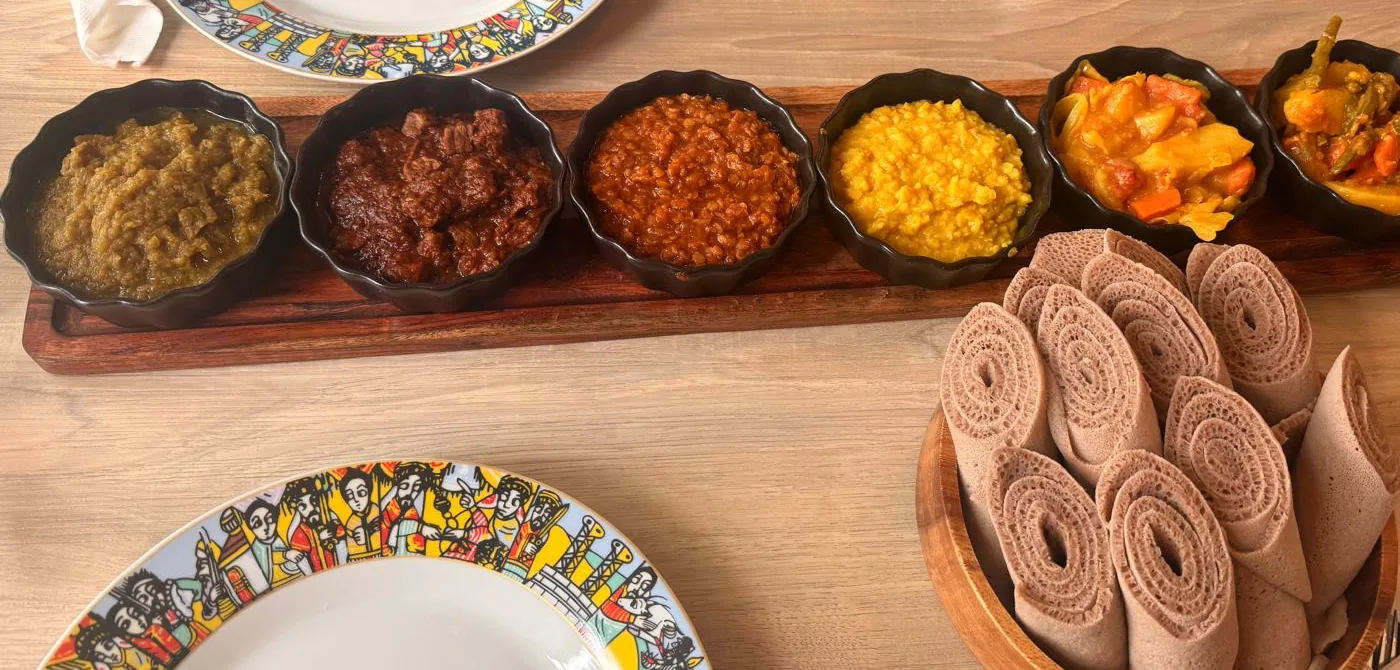
Teff grains are so small that a handful can sow a whole field. Fermented for days into a batter and cooked on a clay griddle, they become the foundation of one of the world's most distinctive cuisines.
Safety
Injera sold in restaurants and shops is frequently made with wheat or barley flour blended into the teff. If you have coeliac disease, do not assume it is gluten-free — ask, and only accept it if it is confirmed 100% teff.
Make it
Simplified injera
6 flatbreads · 20 min active · 2–3 days fermenting
Ingredients
- 2 cups teff flour (ivory teff is milder; brown is more traditional and more strongly flavoured)
- 3 cups water, plus more to adjust
- ½ tsp salt, added at the end
- A large non-metallic bowl
Instructions
- Whisk the teff flour and water into a thin, smooth batter — about the consistency of single cream. Cover loosely with a cloth.
- Leave at room temperature 2–3 days. It will bubble, separate, and smell distinctly sour. That is exactly right. Pour off any dark liquid that rises to the top.
- Stir the batter back together and add the salt. It should pour easily; loosen with water if it has thickened.
- Heat a large non-stick pan over medium-high with no oil. Pour batter in a spiral from the outside in, covering the base thinly.
- Cover with a lid and cook 2–3 minutes. Do not flip it. It is done when the surface is dry and covered in small holes and the edges lift.
- Slide onto a cloth to cool. Stack once cool, not while hot, or they will stick.
- Reserve half a cup of batter as your starter for next time. That's ersho, and it gets better every batch.
Nutrition notes
Teff is nutritionally unusual among grains, mostly because you can't help but eat it whole.
- Iron. Teff is notably high in iron for a grain. Some of the very high figures in older literature turned out to be soil contamination from traditional threshing on the ground, which is a wonderful example of why food composition data needs care. The genuine content is still good.
- Calcium. Considerably higher than wheat or rice, which matters in a diet where dairy is not the main source.
- Gluten-free. Genuinely, not marginally — teff contains no gluten. Note that commercially sold injera is very often cut with wheat or barley flour to reduce cost, so it cannot be assumed safe for coeliac disease unless it is specifically stated to be 100% teff.
- Resistant starch. Teff carries a good amount, which behaves more like fibre than starch and feeds gut bacteria.
The fermentation earns its keep. Whole grains contain phytic acid, which binds iron, zinc and calcium and reduces how much you absorb. Extended fermentation — and injera's is long, up to three days — substantially breaks phytates down. So the same process that creates the sourness and the holes also improves the mineral availability of the grain.
That's a pattern worth noticing across this whole atlas. Traditional processing methods repeatedly turn out to have a nutritional logic that nobody could have articulated at the time. They were selected for over generations because they produced better food and healthier people, by trial, error and observation.
Where a supplement might come in
Injera is a good closing argument for the whole atlas, so let me make it plainly.
You could take an iron supplement, a calcium supplement, a fibre supplement and a probiotic. Or you could eat a whole grain that carries iron and calcium, fermented in a way that makes those minerals more available, alongside stews built on legumes and vegetables.
The traditional food is not automatically better — that's a romantic idea and it doesn't survive contact with the evidence. Iron deficiency is common in Ethiopia; a traditional diet is not a guarantee of anything. But it does illustrate the principle I keep coming back to: food arrives as a package. The mineral comes with the fibre, the fermentation, the meal it's eaten with, and the people you eat it with.
Supplements are single notes. Occasionally a single note is precisely what's needed — B12 on a plant-based diet, vitamin D through a Canadian winter, iron where bloodwork shows a real deficiency. The rest of the time, I'd rather send you to the kitchen.
Where it comes from
Teff was domesticated in the Ethiopian highlands somewhere between four and six thousand years ago, and it remains the staple grain there. The seeds are minute — under a millimetre — which means you always eat the whole grain, bran and germ included. There's no practical way to refine it.
Injera is made by mixing teff flour with water and leaving it to ferment for one to three days with ersho, a starter reserved from the previous batch. The wild yeasts and bacteria sour the batter and produce the gas that gives injera its characteristic honeycomb of holes — the eyes.
It's cooked on a large clay mitad on one side only, and comes off flexible and slightly leathery. At the table it's laid out flat and the stews go directly on top. You tear pieces to scoop with. There are no plates and no utensils, and the bread that has been soaking up sauce underneath is eaten last, which is the best part.
Eating from a shared injera is a genuinely communal act, and the practice of gursha — feeding a piece to someone else by hand — carries real social weight.
Nutrients noted for this entry: Iron · calcium · resistant starch · gluten-free protein.
Please read
This is general food and nutrition education, not medical advice. Nothing here is intended to diagnose, treat, cure or prevent any disease or condition. If you are pregnant or breastfeeding, taking any medication, or managing a diagnosed condition, speak with your doctor or pharmacist before making changes.
Written by Mellissa Wallace, Registered Holistic Nutritionist, Okanagan BC.
More from the land
Keep reading
Korea
김치
No. 01