
Home › From the Land › No. 11
Miso
Soybeans, salt and a mould called koji, left alone for anything from three months to three years.
- Region
- Japan
- Season
- Traditionally started in winter
- Practice
- Ferment
- Plant / organism
- Aspergillus oryzae · Glycine max
- Tradition
- Over 1,000 years; koji use older still
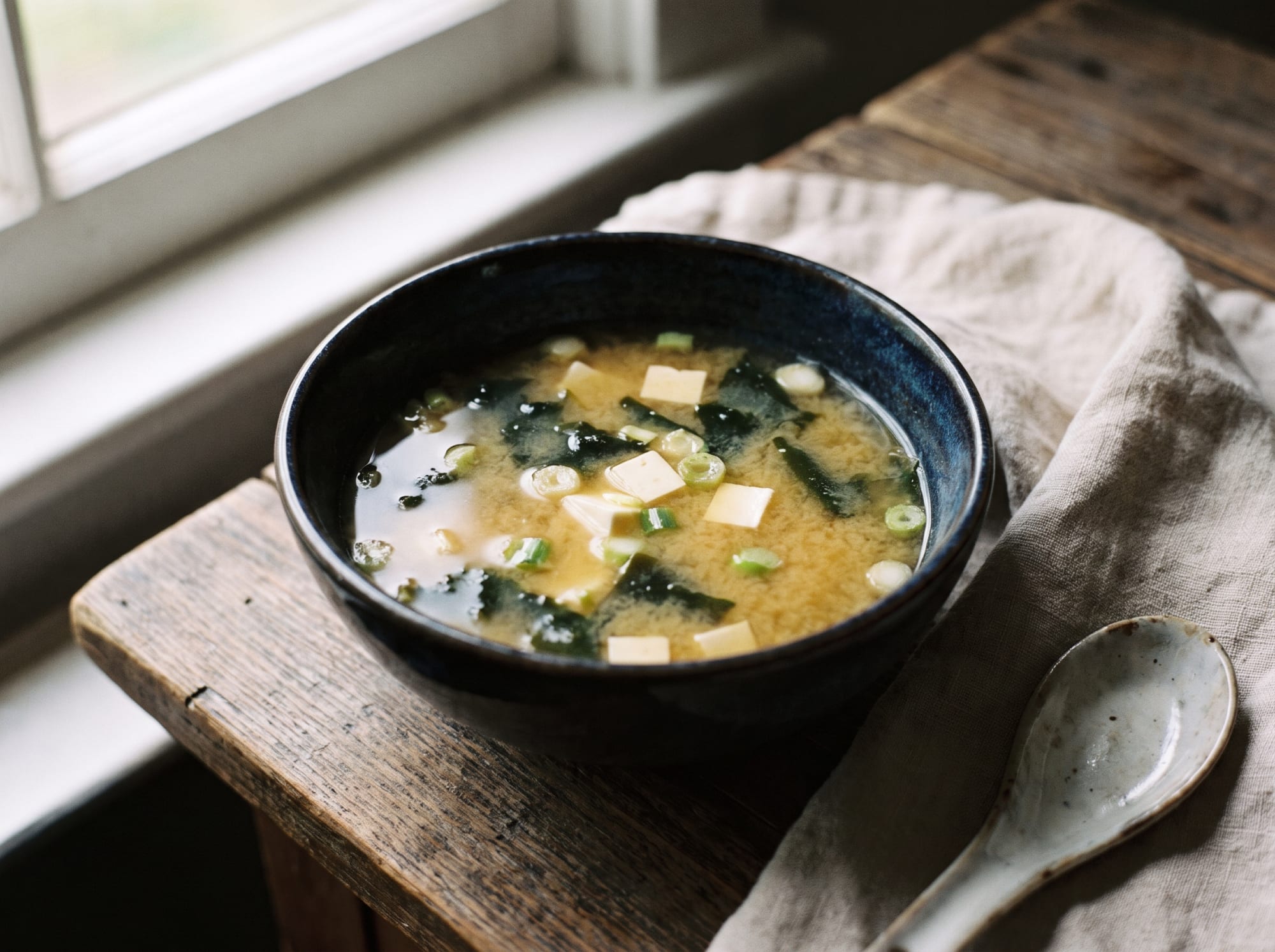
Miso is what happens when you let a specific mould loose on cooked soybeans under salt. It is also the reason Japanese cooking tastes savoury in a way that's hard to reproduce any other way.
Safety
Vitamin K affects how warfarin and similar anticoagulants work. If you take one, speak to your pharmacist before making a large or sudden change to how much fermented soy or leafy greens you eat, and before starting any vitamin K supplement.
Make it
Miso soup, done properly
Serves 4 · 20 minutes
Ingredients
- 1 L water
- 10g kombu (dried kelp)
- 10g katsuobushi (bonito flakes) — or another 10g kombu plus 2 dried shiitake for a vegan dashi
- 3–4 tbsp miso paste (start with 3)
- 200g silken or firm tofu, cubed
- 2 spring onions, sliced thin
- A handful of wakame, soaked 5 minutes and drained
Instructions
- Wipe the kombu but don't wash off the white bloom — that's flavour. Soak it in the cold water 30 minutes if you have time.
- Heat slowly and remove the kombu just before the water boils. Boiling kombu turns the stock bitter and slippery.
- Add the katsuobushi, take the pan off the heat immediately, and let it steep 2 minutes. Strain. You now have dashi, which is the foundation of an enormous amount of Japanese cooking.
- Return the dashi to a gentle heat and add the tofu and wakame. Warm through — do not boil.
- TAKE THE PAN OFF THE HEAT. Put the miso in a ladle, add a little hot dashi, and whisk it smooth before stirring it back into the pot. This is the step that matters.
- Taste and adjust. Scatter the spring onion over and serve straight away.
Nutrition notes
What fermentation does to the soybean. Koji enzymes break the soy proteins down into free amino acids — including a great deal of glutamate, which is why miso tastes so savoury. Those enzymes also break down phytates, which improves mineral availability, and pre-digest much of the protein, which is part of why miso sits easily with people who find whole soy heavy.
Vitamin K2. Fermented soy foods are among the few meaningful dietary sources of vitamin K2, which is involved in directing calcium into bone. Natto is by far the richest source; miso contributes usefully.
Live organisms. Unpasteurised miso contains live cultures — which is exactly why you must not boil it. Adding miso to a rolling pot kills them and coarsens the flavour at the same time. Stir it into liquid that has come off the heat.
The salt question, honestly. Miso is around 12% salt. That sounds alarming and the epidemiology is more interesting than you'd expect: Japanese cohort studies have generally not found the increase in blood pressure or cardiovascular risk that the sodium content alone would predict. Several explanations have been proposed — the potassium and soy peptides that come with it, the modest amounts actually used. I'd treat this as genuinely unresolved rather than a green light. If you've been told to watch sodium, treat miso as the salt in the dish, not as a free extra.
Where a supplement might come in
This is a good place to talk about vitamin K2, because it's a supplement I get asked about regularly.
K2 supplements — usually MK-7 — are sold heavily for bone and cardiovascular health. The research is genuinely interesting and genuinely unsettled. There's reasonable evidence around bone density markers, and much more speculative claims made about arterial calcification.
The critical safety point: vitamin K interacts with warfarin. This is not a theoretical concern — it directly affects how the drug works. If you take warfarin or any similar anticoagulant, do not start a K2 supplement, or dramatically change how much fermented soy or leafy greens you eat, without talking to the person managing your medication. That is a pharmacist or doctor conversation, and they will happily have it with you.
For everyone else: fermented soy, leafy greens and some cheeses cover K reasonably well, and I'd start there.
Where it comes from
The organism doing the work is Aspergillus oryzae — koji — which Japan designated its national fungus in 2006. That's not a joke; it is genuinely foundational to the cuisine, underlying miso, soy sauce, mirin and sake.
Koji is grown first on rice or barley, then mixed with cooked soybeans and salt and left to age. What comes out depends almost entirely on time and proportion. Shiro (white) miso is aged a few months, sweet and mild. Aka (red) is aged a year or more, dark and assertive. Hatcho miso from Aichi is aged two to three years in cedar barrels weighted with river stones, and tastes like it.
Households historically made their own, and the phrase temae miso — "my own miso" — came to mean self-praise, which tells you how proud people were of theirs.
Nutrients noted for this entry: Complete plant protein · vitamin K2 · glutamates · live organisms.
Please read
This is general food and nutrition education, not medical advice. Nothing here is intended to diagnose, treat, cure or prevent any disease or condition. If you are pregnant or breastfeeding, taking any medication, or managing a diagnosed condition, speak with your doctor or pharmacist before making changes.
Written by Mellissa Wallace, Registered Holistic Nutritionist, Okanagan BC.
More from the land
Keep reading
Korea
김치
No. 01