
Home › From the Land › No. 14
Stinging Nettle
It stings until you cook it, and then it is one of the most nutrient-dense greens you can pick for free.
- Region
- Temperate worldwide
- Season
- Young tops, early spring only
- Practice
- Forage
- Plant / organism
- Urtica dioica
- Tradition
- Food, fibre and medicine across Europe for millennia
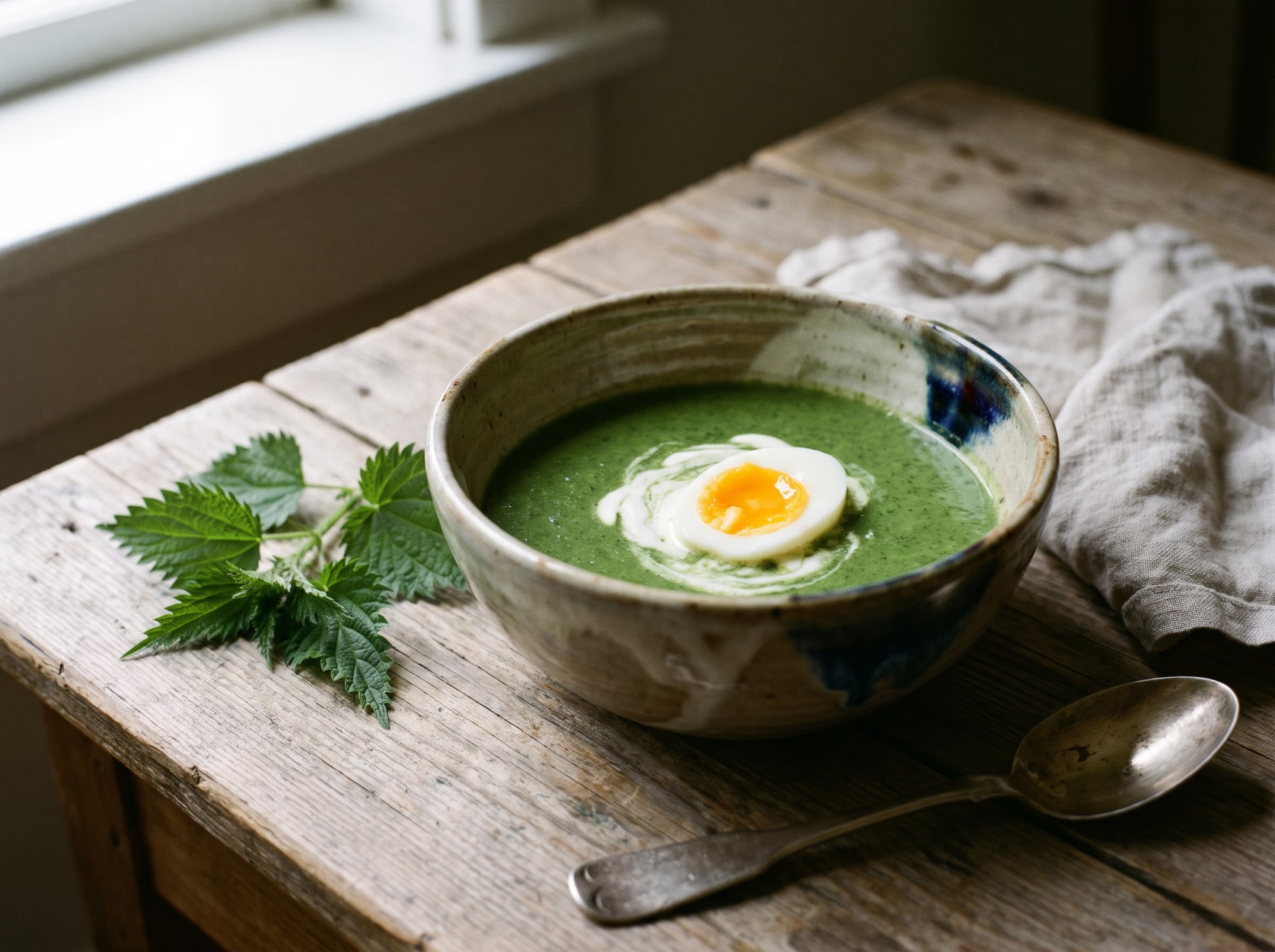
Nettle is the plant that most rewards knowing one small fact: heat destroys the sting completely. Thirty seconds in boiling water and it becomes an ordinary, excellent green.
Safety
Nettle has real interactions. Please read this.
Only young spring tops. Do not eat nettle once it has flowered — older plants contain gritty cystoliths that can irritate the kidneys.
Always cook or thoroughly dry it. Raw nettle stings the mouth and throat.
Medication. Nettle can interact with blood thinners (it is high in vitamin K), diuretics, blood pressure medication, lithium and diabetes medication. If you take any of these, talk to your pharmacist before eating nettle regularly or taking any nettle product.
Pregnancy. Avoid medicinal amounts of nettle in pregnancy without medical advice.
Where you pick. Nettle grows enthusiastically on disturbed and fertilised ground, including old farmyards and roadsides. Pick well away from traffic, sprayed land and anywhere dogs go.
Make it
Nettle soup
Serves 4 · 35 minutes
Ingredients
- A carrier bag of young nettle tops (about 300g), picked wearing gloves
- 1 onion, chopped
- 2 medium potatoes, peeled and diced
- 1 leek, sliced
- 2 tbsp butter
- 1 L vegetable or chicken stock
- A grating of nutmeg
- Lemon, salt, black pepper
- Cream or yoghurt and a soft-boiled egg, to serve
Instructions
- Wearing gloves, pick over the nettles and keep only the top four to six leaves of each shoot. Discard anything flowering, and anything tough.
- Wash them in a sink of cold water — still wearing gloves — and lift them out rather than pouring, so the grit stays behind.
- Blanch 30 seconds in a large pan of boiling water. The sting is gone the moment they wilt. Lift them out and you can handle them bare-handed from here.
- Soften the onion and leek in the butter for 8 minutes without colouring. Add the potato and stock, and simmer 15 minutes until the potato is soft.
- Add the blanched nettles and cook 3 minutes more. Any longer and the colour dulls.
- Blend until smooth. Season hard, add nutmeg, and finish with a good squeeze of lemon — it lifts the whole thing and helps you absorb the iron.
- Serve with a spoon of cream or yoghurt and half a soft-boiled egg.
Nutrition notes
Nettle is unusually well-provisioned for a leaf. Cooked nettle carries meaningful iron and calcium, a good deal of vitamin K, and more protein than most leafy greens — enough that it behaves more like a legume-adjacent food than a lettuce.
The iron comes with the usual caveat. It is non-heme iron, absorbed less efficiently than iron from meat. Vitamin C alongside helps, which is a good reason to finish nettle soup with lemon. Nettle also contains oxalates, which bind some of the calcium and iron; boiling and discarding the water reduces oxalates considerably, at the cost of some of the minerals. There is no perfect answer here, and it is the same trade-off as spinach.
The sting. The hairs are tiny hollow needles that inject a mix of histamine, formic acid and other irritants. Heat, drying and thorough crushing all destroy them. Cooked or properly dried nettle cannot sting you.
What I would not claim. Nettle root is studied for benign prostatic hyperplasia and nettle leaf for allergic rhinitis and joint pain. Some of that research is interesting; none of it is settled, and none of it is a claim I can make about soup. If any of those are your concern, that is a doctor's conversation.
Where a supplement might come in
Nettle leaf and nettle root are sold separately and are used for quite different things, which is worth knowing before you buy either.
Nettle root is the one with the more substantial research base, in prostate health. That is a medical question and belongs with a physician, not a website.
Nettle leaf capsules are usually sold for allergies or joints. The evidence is thin. If you want nettle leaf, dried nettle tea is inexpensive and pleasant, and I would start there rather than with a supplement.
For iron specifically: eating nettle is a nice contribution and not a treatment for deficiency. If you suspect your iron is low, get a blood test. Never supplement iron on a guess.
Where it comes from
Nettle has fed and clothed people across Europe for a very long time. The fibres were spun into cloth — nettle textile survives from the Bronze Age, and German army uniforms were made partly of nettle in the First World War when cotton ran short.
As food it was a spring staple: the first substantial green after a winter of stored roots, arriving exactly when people most needed it. Nettle soup appears across Scotland, Ireland, Scandinavia, Eastern Europe and the Balkans under a dozen names.
The rule everywhere is the same: pick only the young tops, in spring, before the plant flowers. Once nettle flowers it develops gritty particles called cystoliths, which are hard on the kidneys and unpleasant to eat. After flowering, leave it alone.
Wear gloves. Everyone thinks they can manage without gloves. Everyone is wrong once.
Nutrients noted for this entry: Iron · calcium · vitamin K · protein for a leafy green.
Please read
This is general food and nutrition education, not medical advice. Nothing here is intended to diagnose, treat, cure or prevent any disease or condition. If you are pregnant or breastfeeding, taking any medication, or managing a diagnosed condition, speak with your doctor or pharmacist before making changes.
Written by Mellissa Wallace, Registered Holistic Nutritionist, Okanagan BC.
More from the land
Keep reading
Northern Europe · BC
Rosa canina
No. 05