
Home › From the Land › No. 08
Wild Mushrooms
BC exports thousands of kilos of pine mushrooms to Japan every autumn. Most people here have never eaten one.
- Region
- British Columbia · Japan
- Season
- Autumn, after rain
- Practice
- Forage
- Plant / organism
- Tricholoma murrillianum · Cantharellus formosus
- Tradition
- Pine mushroom prized in Japan for 1,200 years
This is the one food in the atlas where getting it wrong can kill you, so the safety section is longer than the recipe. It is also, when done properly, one of the great pleasures of a BC autumn.
Safety
This is the one that can kill you. I am not being dramatic.
Never eat a wild mushroom unless an experienced person has confirmed the identification in the flesh. Not from a photo, not from an app, not from a website — including this one. Several deadly species look unremarkable, and Amanita phalloides (death cap) is now well established in parts of BC, including in cities.
Death cap poisoning has a particularly cruel pattern: severe symptoms, then an apparent recovery lasting a day or two, then liver failure. People have died because the middle phase convinced them they were fine.
What to actually do: join a local mycological society — BC has excellent ones and they run forays with experienced identifiers. Learn a small number of unmistakable species properly rather than a large number vaguely. Cook every wild mushroom thoroughly. Try only one new species at a time, in a small amount, and keep a specimen aside in case a hospital needs it.
If you suspect mushroom poisoning, call your poison control centre immediately and take the mushroom with you. Do not wait to see whether it passes.
Make it
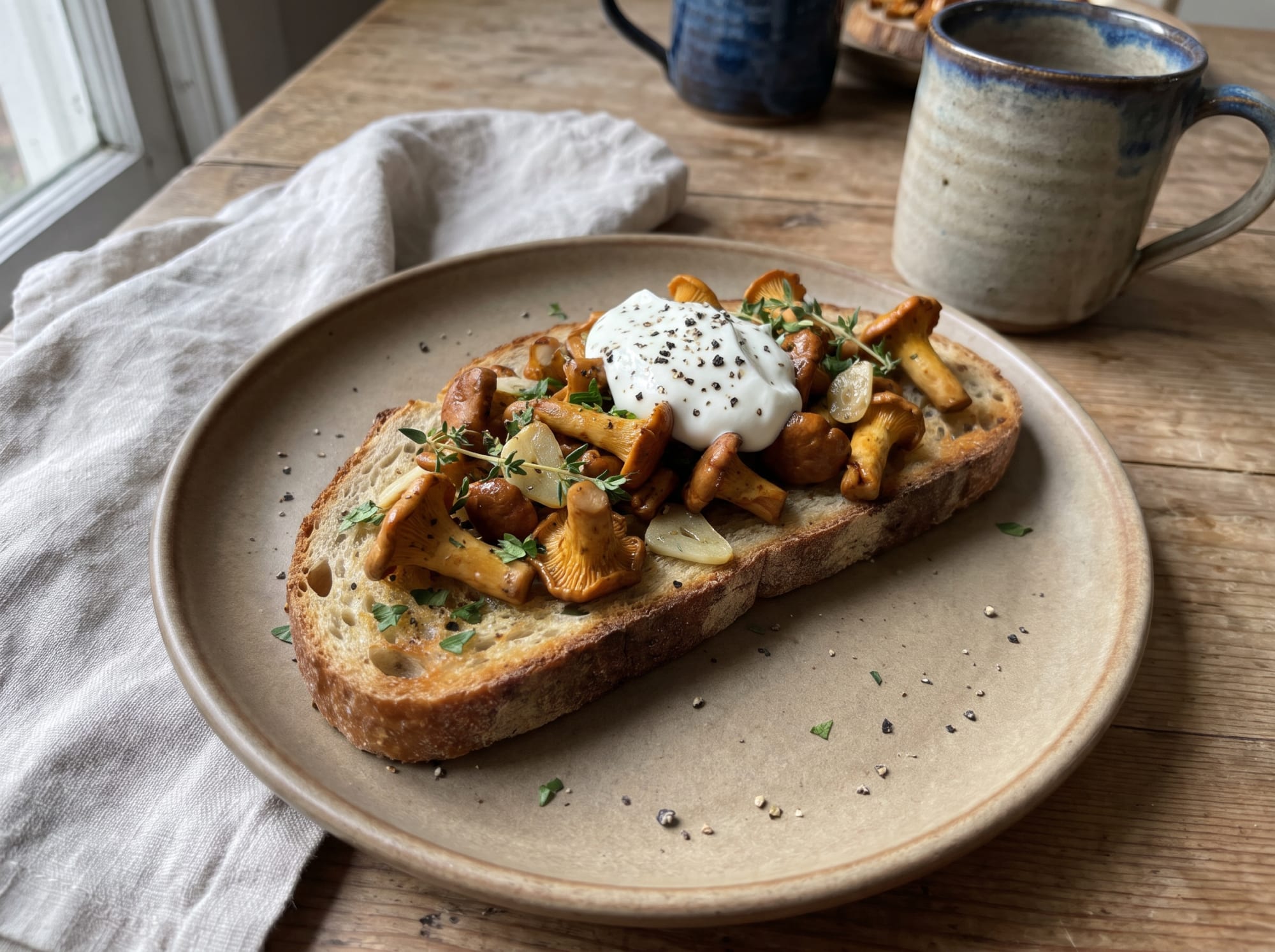
Chanterelles on toast
Serves 2 · 15 minutes
Ingredients
- 300g fresh chanterelles (or any mushroom you have identified with certainty)
- 2 thick slices good sourdough
- 1 tbsp butter and 1 tbsp olive oil
- 1 clove garlic, sliced thin
- 2 sprigs thyme
- A splash of dry sherry or white wine
- 2 tbsp crème fraîche
- Parsley, salt, plenty of black pepper
Instructions
- Clean the mushrooms with a brush or a barely damp cloth. Don't soak them — they hold water like a sponge and then steam instead of frying.
- Tear anything large in half lengthways; leave small ones whole.
- Get the pan properly hot with the oil. Add the mushrooms in a single layer and leave them alone for 2 minutes. They will release water; keep the heat up until it has boiled off.
- Add the butter, garlic and thyme. Cook another 2–3 minutes until golden at the edges.
- Splash in the sherry and let it bubble away. Stir in the crème fraîche and take off the heat.
- Pile onto toast, season hard, and add parsley. Do not add cheese. Chanterelles do not need help.
Nutrition notes
Vitamin D is the genuinely interesting one. Mushrooms contain ergosterol, which converts to vitamin D2 when exposed to ultraviolet light — the same reaction that happens in your own skin. A mushroom that grew in shade has very little. One that has been exposed to UV can have a great deal.
You can do this at home: lay mushrooms gills-up in direct sunlight for a few hours. Studies have found substantial increases in vitamin D2 content this way. It's a real effect and it costs nothing.
Two honest caveats. D2 appears somewhat less effective than D3 at raising and maintaining blood levels. And at this latitude, through a BC winter, this is a contribution rather than a solution.
Beta-glucans. Mushroom cell walls contain beta-glucan polysaccharides, which have real and well-documented effects on immune cells in laboratory settings. The human clinical picture is far less settled than the supplement marketing suggests. I'd file this as genuinely interesting, actively researched, and not yet something to make claims about.
Straightforwardly: mushrooms are a good source of selenium, copper and several B vitamins, they're low in calories, and they carry savoury glutamates that make food taste better. That's enough reason to eat them without reaching for anything more dramatic.
Where a supplement might come in
Medicinal mushroom supplements — reishi, lion's mane, chaga, turkey tail — are a large and fast-growing category. Some are genuinely under serious research, particularly in oncology support settings, under medical supervision. That is a very long way from what's sold over the counter for general wellness.
Two practical things worth knowing if you're buying them. Many products are made from mycelium grown on grain, and the grain is included in the finished powder — so a good part of what you're paying for may be starch rather than mushroom. And extraction matters: beta-glucans need hot water extraction to be available at all, so raw powdered products may deliver very little.
Vitamin D is the supplement genuinely worth discussing here, and not because of mushrooms. At Canadian latitudes most people make little to none from sunlight for a good part of the year. Whether you need it, and at what dose, depends on your bloodwork — which means your doctor, not a guess.
Where it comes from
The Japanese matsutake has been a luxury for over a millennium — referenced in Heian-period poetry, given as a formal autumn gift, and priced accordingly. Japanese domestic harvests collapsed through the twentieth century as pine forests changed, and by the 1980s buyers were sourcing internationally.
Which is how a closely related species growing in British Columbia became a significant export industry. Every autumn, pickers work the BC interior and the coast, and the mushrooms are graded, chilled and air-freighted to Japan within days. It has been an important seasonal income for many rural and Indigenous communities here.
Chanterelles are the other great BC autumn mushroom — golden, apricot-scented, and abundant in coastal forest after the rains start.
Mushroom picking across much of Europe carries a cultural weight that's largely absent here. In Poland, Russia, Ukraine and the Nordic countries it's a normal family autumn activity, with knowledge passed down and, in some countries, pharmacists who will identify your basket for free.
Nutrients noted for this entry: Vitamin D (when UV-exposed) · selenium · B vitamins · beta-glucans.
Please read
This is general food and nutrition education, not medical advice. Nothing here is intended to diagnose, treat, cure or prevent any disease or condition. If you are pregnant or breastfeeding, taking any medication, or managing a diagnosed condition, speak with your doctor or pharmacist before making changes.
Written by Mellissa Wallace, Registered Holistic Nutritionist, Okanagan BC.
More from the land
Keep reading
Northern Europe · BC
Rosa canina
No. 05