
Home › From the Land › No. 15
Yarrow
The feathery-leaved plant on every dry roadside verge, and the one in this collection I would treat with the most respect.
- Region
- Northern hemisphere
- Season
- Flowering tops, midsummer
- Practice
- Infuse
- Plant / organism
- Achillea millefolium
- Tradition
- Named for Achilles; used across Europe and North America
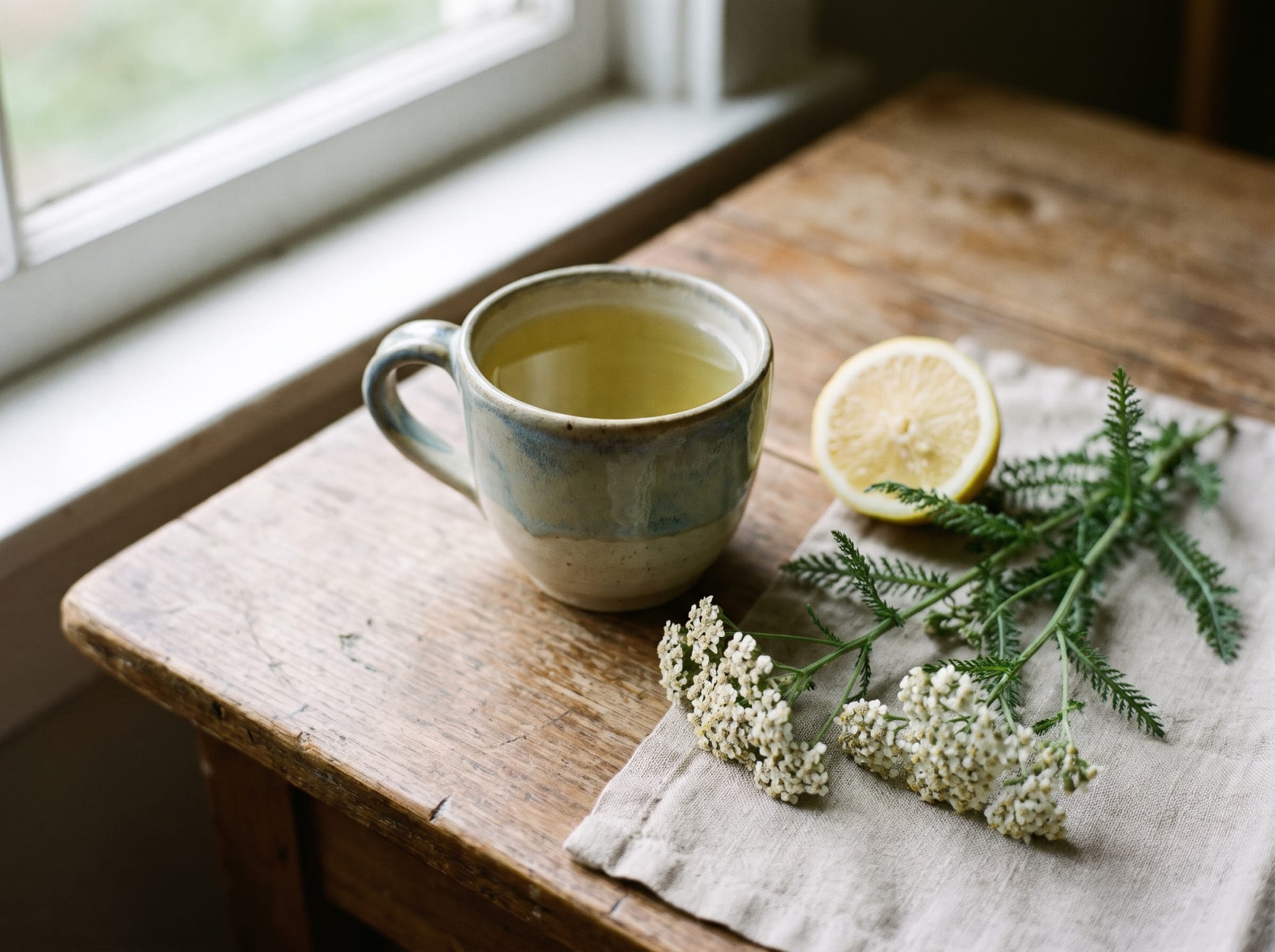
Yarrow is a herb before it is a food, and I have included it partly to make that distinction clearly. Its cautions are longer than its recipe, and that is the honest proportion.
Safety
Yarrow has the longest caution list here. Please read all of it.
Do not use in pregnancy. Yarrow has traditionally been used to affect menstruation and is generally considered unsafe in pregnancy. Avoid while breastfeeding too, without medical advice.
Identification. Yarrow grows in the same places as several members of the carrot family, which include Conium maculatum (poison hemlock) and Cicuta (water hemlock) — both deadly. Yarrow's feathery, finely divided leaves are quite distinct from hemlock's, but do not rely on the flat white flower clusters alone, because those look similar at a glance. If you are not completely certain, do not pick it.
Allergy. Yarrow is in the Asteraceae family. If you react to ragweed, chrysanthemum, marigold or daisy, avoid it.
Medication. May interact with blood thinners, blood pressure and sedative medication, and lithium. Check with your pharmacist.
Photosensitivity. Yarrow can make some people's skin more sensitive to sunlight.
Not for long-term daily use, and not for children, without professional guidance.
Make it
Yarrow tea, as a bitter
1 small cup · 10 minutes
Ingredients
- 1 tsp dried yarrow flowering tops (or 2 tsp fresh), correctly identified
- 1 cup just-boiled water
- Honey and lemon, which it needs
Instructions
- Harvest only the flowering tops, in midsummer, from clean ground away from roads and sprayed land.
- Dry them in a paper bag somewhere warm and airy, or use them fresh.
- Pour just-boiled water over, cover, and steep 10 minutes. Covering keeps the volatile oils in the cup.
- Strain. It is properly bitter and aromatic — honey and lemon are not optional for most people.
- A small cup, occasionally, before a meal. Not a daily habit, and not by the potful.
Nutrition notes
I want to be careful and proportionate here, because yarrow is a plant where the traditional reputation runs well ahead of the human evidence.
What is in it. Yarrow contains volatile oils including chamazulene, plus flavonoids, tannins and bitter sesquiterpene lactones. Those bitter compounds are also the main allergy concern.
The wound reputation. There is laboratory work on yarrow extracts and wound healing, and the tannins give a plausible astringent mechanism. Human clinical evidence is limited. This is a case where a long tradition and a plausible mechanism have not yet been matched by good trials, and I am not going to imply otherwise.
As a bitter. Like dandelion, yarrow is bitter, and bitters stimulate digestive secretions. That is a modest, real effect and probably the most defensible everyday use.
What I would not do. Use it as a treatment for anything, take it daily over long periods, or take it at all in the situations listed below. It is a herb with genuine pharmacological activity, which is precisely why it deserves respect rather than casual use.
Where a supplement might come in
Yarrow is sold as tea, tincture and capsules. Given how limited the human evidence is and how long the caution list is, this is not a supplement I would reach for, and not one I would suggest to a client without a specific reason and a conversation with their doctor first.
I have included yarrow in this collection because it was part of how I learned about plants, and because it makes an honest point: a plant having a long and respected traditional history does not automatically make it a good idea for you, today, alongside whatever else you are taking. Traditional knowledge is worth taking seriously. Taking it seriously includes taking its cautions seriously.
Where it comes from
You will know it by the leaves before the flowers — finely divided, almost feathery, which is what millefolium, thousand-leaf, refers to. The flowers are flat-topped clusters of small white or occasionally pink blooms, in midsummer, on dry ground and roadsides.
Its reputation is old and consistently about wounds. The genus is named for Achilles, said to have carried it to treat his soldiers, and the common names across Europe — soldier's woundwort, staunchweed, knight's milfoil — all point the same way.
It has been used across many Indigenous North American traditions as well, in ways that vary considerably between nations and that I am not the right person to describe.
As a drink it is bitter and aromatic, usually taken as a small cup rather than something you sit down to enjoy by the pot.
Nutrients noted for this entry: Volatile oils · flavonoids · bitter compounds.
Please read
This is general food and nutrition education, not medical advice. Nothing here is intended to diagnose, treat, cure or prevent any disease or condition. If you are pregnant or breastfeeding, taking any medication, or managing a diagnosed condition, speak with your doctor or pharmacist before making changes.
Written by Mellissa Wallace, Registered Holistic Nutritionist, Okanagan BC.
More from the land
Keep reading
India
मसाला चाय
No. 03