
Home › From the Land › No. 06
Mullein
The tall, felted weed on every roadside — and one of the oldest recorded cough remedies in Europe.
- Region
- Europe · naturalised across Canada
- Season
- Leaves summer · flowers midsummer
- Practice
- Infuse
- Plant / organism
- Verbascum thapsus
- Tradition
- Dioscorides, 1st century CE
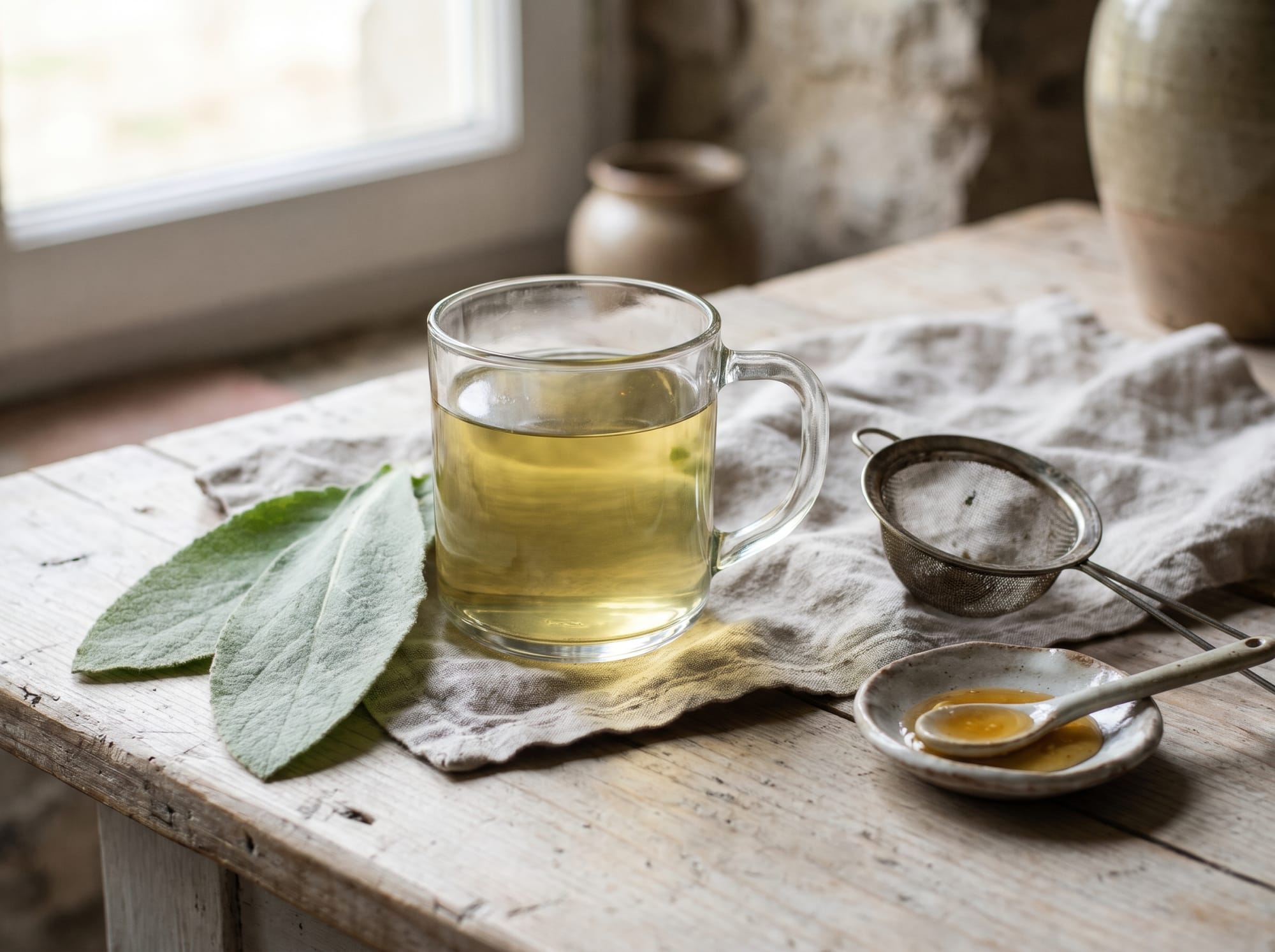
Mullein is the plant most likely to be growing near you already without your noticing. It's also the entry in this atlas where I most want to be careful about what I claim.
Safety
Read this before making it. Always strain mullein through a coffee filter or fine muslin — the leaf hairs irritate the throat and defeat the point. Avoid the seeds, which contain compounds toxic to fish and were historically used to stun them. Do not use during pregnancy or breastfeeding without medical advice. And a cough lasting more than three weeks, or any cough with blood, fever, breathlessness or chest pain, needs a doctor now — not a tea.
Make it
Mullein leaf infusion
1 cup · 10 minutes
Ingredients
- 1–2 tsp dried mullein leaf, or 2–3 fresh leaves torn up
- 1 cup just-boiled water
- A very fine strainer, coffee filter, or muslin — this is essential, not optional
- Honey and lemon to taste
Instructions
- Put the leaf in a cup or small pot and pour over the just-boiled water.
- Cover and steep 10 minutes. Covering matters — it keeps the volatile compounds in the cup rather than in the room.
- Strain through a coffee filter or fine muslin. A standard tea strainer will not hold back the fine leaf hairs, and those hairs are irritating to the throat — which rather defeats the purpose.
- Add honey if you like. Honey has better evidence for soothing a cough than mullein does, so it's earning its place.
Nutrition notes
I'm going to be more cautious here than most sites you'll read, because the gap between mullein's traditional reputation and its actual evidence base is wide.
What's in it. Mullein leaves and flowers contain mucilage — soluble polysaccharides that swell into a gel with water. They also contain saponins, iridoid glycosides and flavonoids.
The plausible mechanism. Mucilage coats the throat, and there is a reasonable physical explanation for why a demulcent might ease the sensation of a dry irritated throat: it's a coating effect, not a pharmacological one. This is the same reason honey helps, and honey has better evidence than mullein does.
What the evidence actually is. Laboratory studies on mullein extracts show some antimicrobial and anti-inflammatory activity. Human clinical trials are very limited. There is not good evidence that mullein tea treats any respiratory condition, and I'm not going to imply otherwise.
What I'll say honestly: it's a pleasant, mild, faintly sweet tea with a long history and a plausible soothing effect. That's a reasonable thing to enjoy. It is not a treatment, and a cough that persists needs a doctor, not a herb.
Where a supplement might come in
Mullein is sold as capsules, tinctures and — increasingly and worryingly — as vape products marketed for "lung cleansing". I'd avoid the last category entirely; inhaling anything combusted or vaporised is not a route to healthier lungs, and there is no evidence behind those products at all.
For the tea and tinctures: they're inexpensive and generally well tolerated in ordinary amounts. I just wouldn't expect much, and I'd want you to see a doctor about anything persistent rather than working through the herbal aisle.
Where it comes from
You've seen it: a rosette of soft, grey-green, almost furry leaves in the first year, then a single tall flower spike in the second, sometimes two metres high, studded with small yellow flowers. It colonises disturbed ground, roadsides and gravel with great enthusiasm.
Dioscorides wrote about it in the first century. It appears in European herbals continuously from then on, almost always for the same purpose: dry, irritating coughs and chest complaints. The dried stalks were also dipped in tallow and burned as torches, which is where "candlewick plant" comes from.
It travelled to North America with European settlers and naturalised aggressively. It was subsequently adopted into a number of Indigenous North American practices, though the plant itself is an introduction, not native.
Nutrients noted for this entry: Mucilage · saponins · flavonoids.
Please read
This is general food and nutrition education, not medical advice. Nothing here is intended to diagnose, treat, cure or prevent any disease or condition. If you are pregnant or breastfeeding, taking any medication, or managing a diagnosed condition, speak with your doctor or pharmacist before making changes.
Written by Mellissa Wallace, Registered Holistic Nutritionist, Okanagan BC.
More from the land
Keep reading
India
मसाला चाय
No. 03