
Home › From the Land › No. 10
Pelmeni
Made by the hundred, frozen outside in the snow, and eaten all winter. The original convenience food.
- Region
- Siberia · Urals
- Season
- Deep winter
- Practice
- Everyday
- Plant / organism
- —
- Tradition
- Komi and Udmurt origin; Slavic adoption
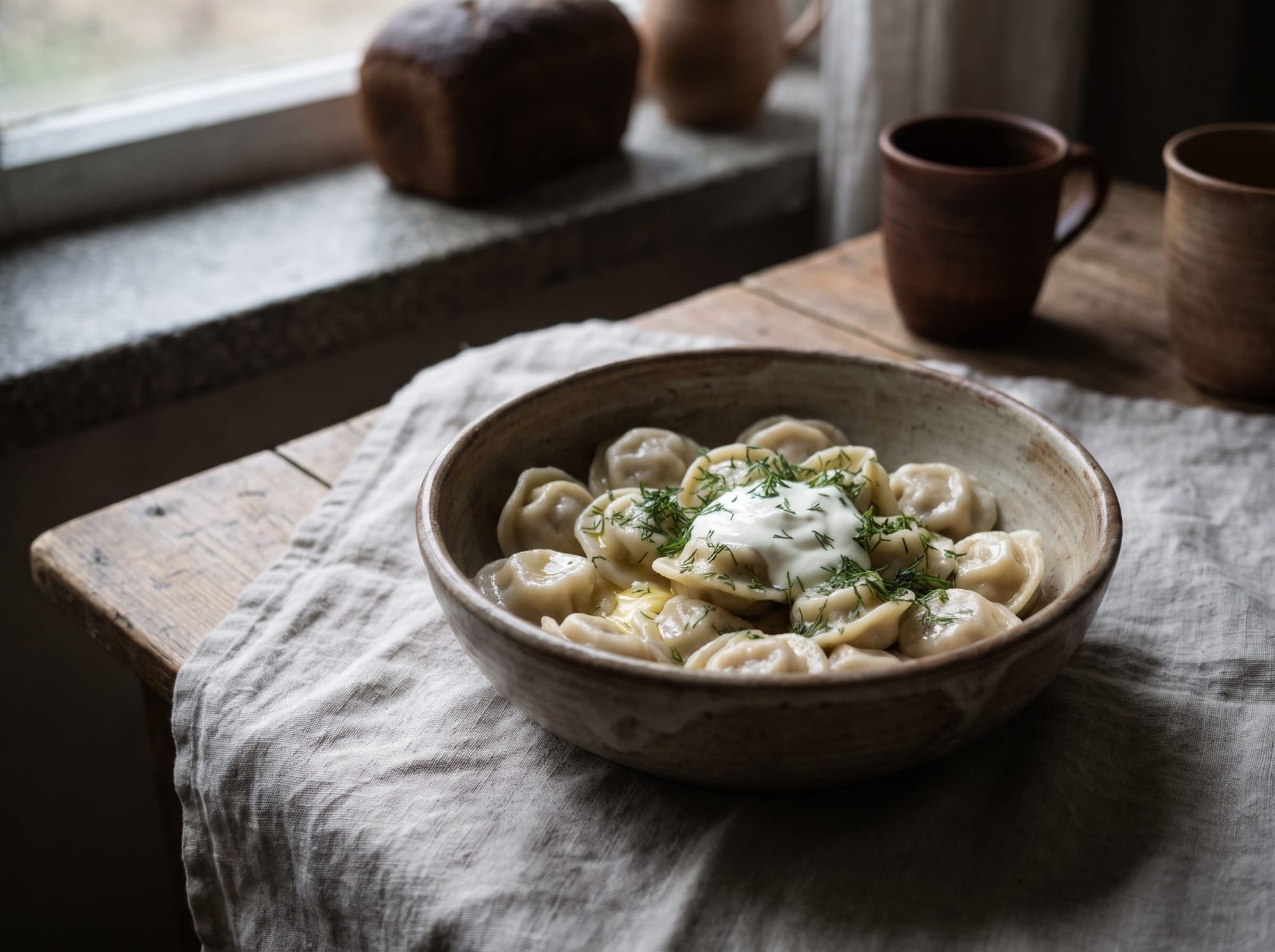
The name comes from Komi and Udmurt words meaning roughly 'bread ear'. The practice comes from a very practical observation: it gets cold enough in Siberia to use the outdoors as a freezer.
Make it
Pelmeni for the freezer
About 60 dumplings · 2 hours · freezes 3 months
Ingredients
- DOUGH — 500g plain flour, 1 egg, 200ml warm water, 1 tsp salt
- FILLING — 250g minced beef
- 250g minced pork
- 2 onions, grated or very finely chopped
- 1 clove garlic, grated
- 3 tbsp ice-cold water
- 1 tsp salt, plenty of black pepper
- Optional — 150g finely grated cabbage or mushroom, to stretch the meat
- TO SERVE — sour cream, butter, dill, vinegar
Instructions
- Make the dough: mix flour and salt, add the egg and warm water, and knead 10 minutes until smooth and elastic. Wrap and rest 30 minutes — this is not optional, it lets the gluten relax so you can roll it thin.
- Mix all the filling ingredients thoroughly. The ice-cold water is the trick — it keeps the filling juicy rather than dense.
- Roll the dough very thin, about 2mm. Cut 7cm rounds with a glass.
- Put a teaspoon of filling in each round. Fold into a half-moon and press the edges firmly, then bring the two corners together and pinch. That little ring shape is what holds them together in the water.
- To freeze: lay them apart on a floured tray, freeze solid, then bag them. They will not stick together if you freeze them separated first.
- To cook: drop frozen into well-salted boiling water. They're done about 3 minutes after they float — 6 to 8 minutes total.
- Serve with sour cream and dill, or fry the boiled ones in butter until crisp, which is better and nobody talks about it enough.
Nutrition notes
I've included pelmeni to make a point that doesn't get made often enough in nutrition writing: convenience food is not a modern invention, and it isn't inherently bad.
What pelmeni actually are, nutritionally: a portion-controlled parcel of protein wrapped in carbohydrate, cooked in water, eaten with a fermented dairy product. That's a reasonable meal. The filling is typically half meat, half onion — considerably more vegetable than most people assume — and the dough is thin.
The differences between this and a supermarket frozen meal are worth naming, because they're where the real nutritional gap sits:
- You control the salt. Home-made pelmeni have a fraction of the sodium of most commercial frozen equivalents.
- There's nothing else in them. No stabilisers, no added sugars, no fillers — not because those are dangerous, but because they tend to accompany products designed for shelf life rather than for eating.
- The portion is what you decide it is.
Two hours of work once buys you eight or ten dinners. That's the same trade the batch-cooking advice in the meal planning guide is making, arrived at independently a few centuries earlier.
Make them better still: put grated cabbage or mushroom into the filling, use half the meat, and serve with something sharp and green alongside.
Where a supplement might come in
Nothing here, but a note on protein, since that's what a client would ask.
Protein powders are useful in specific situations — genuinely poor appetite, high training loads, some post-surgical recovery, and where food simply isn't going in. For most people they're an expensive way to buy something already sitting in the fridge.
Ten pelmeni deliver roughly the protein of a scoop of whey, alongside a meal you actually want to eat. If your protein intake is low, the fix is almost always structural — a protein at breakfast, a protein at lunch — rather than a tub of powder.
Where it comes from
Pelmeni are small dumplings of unleavened dough around a filling of minced meat, onion and pepper. What makes them culturally distinct isn't the dumpling — nearly every food culture has one — but the industrial scale of the household production.
Families made them communally in enormous batches at the start of winter, hundreds or thousands at a sitting, then put them outside in sacks to freeze solid. Through the winter you took in a handful and boiled them. This was a preservation strategy and a labour strategy at once: one hard day's work in November bought you months of fast dinners.
They travelled with hunters and traders precisely because frozen pelmeni are compact, keep indefinitely in the cold, and become a hot meal with nothing but a pot of water.
Served with smetana (sour cream), butter, vinegar, or in their own broth. There are strong opinions about which, and I'm not getting involved.
Nutrients noted for this entry: Protein · carbohydrate · whatever you put in them.
Please read
This is general food and nutrition education, not medical advice. Nothing here is intended to diagnose, treat, cure or prevent any disease or condition. If you are pregnant or breastfeeding, taking any medication, or managing a diagnosed condition, speak with your doctor or pharmacist before making changes.
Written by Mellissa Wallace, Registered Holistic Nutritionist, Okanagan BC.
More from the land
Keep reading
The Levant
סָלָט יָרָקוֹת
No. 09